

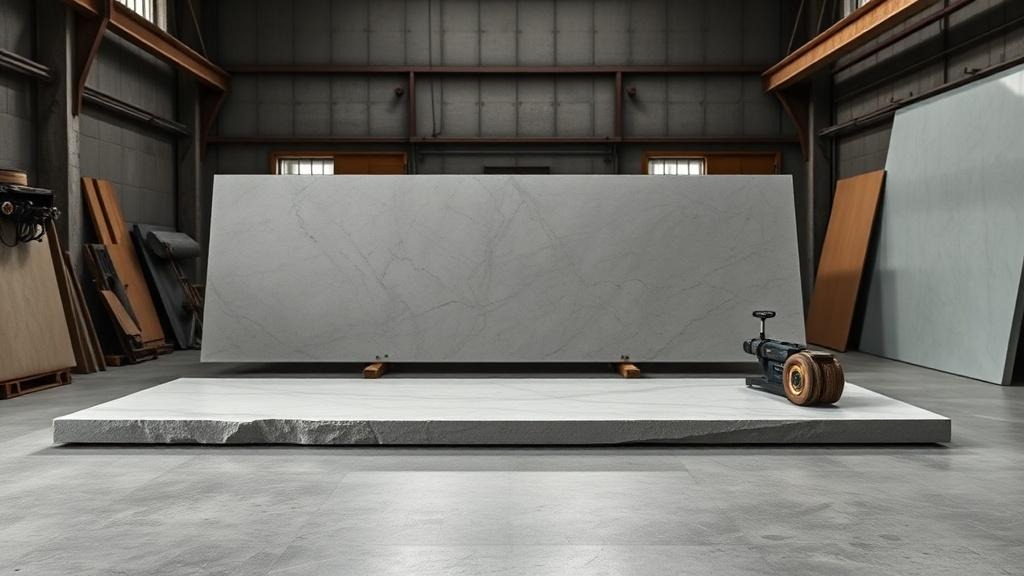
For detailed countertop fabrication reference, the useful answer lives in the shop floor details: slab photos, measurements, install constraints, and whether the team can trust the number before anyone starts fabricating stone.
Last fall I walked through a 4,200-square-foot shop outside Dayton with a guy named Rick who’d been fabricating stone for eleven years. Rick runs three bridge saws (one of them a 2004 Park Yukon he refuses to retire), a Northwood C-12, and a crew of nine. He was doing about 28 jobs a week. His callback rate? Fourteen percent. He knew it was bad. What he didn’t know was where the money was actually leaking, because he’d never mapped his shop as eight connected workstations. He thought of it as “we cut stone and install it.” That framing was costing him roughly $180,000 a year in rework, wasted slab, and crew hours chasing fixes.
Rick’s problem is the norm, not the exception. Most residential shops lose margin not because they’re bad at any single thing but because they treat fabrication as one big job instead of what it actually is: a small factory with eight sequential handoff points, each with its own cost structure, tooling, and failure mode.
The Eight Stations (and Why the Handoffs Are Where Margin Dies)
Here’s the full sequence: slab receiving, templating, nesting, sawing, CNC profiling, polishing, install staging, field install.
Every shop owner reading this can name all eight. But naming them and managing the handoffs between them are completely different activities. The transition from template to nest is where vein-matching errors creep in. The transition from CNC to polish is where edge tolerances slip. The transition from staging to field install is where seams get botched, callbacks pile up, and you end up eating a $400 slab because a $12/hour helper didn’t dry-fit properly.
Shops that run all eight stations with documented practice and weekly metric tracking tend to come in 8 to 15 percent below shops that improvise on quoting. More importantly, they hit 14 to 22 percent net margin and keep callbacks under 4 percent. Shops running loose? Six to 9 percent margin. Callbacks north of 11 percent. The gap between those two profiles, at a $2M residential operation, is the difference between the owner taking home a real salary and the owner subsidizing chaos.
Some baseline numbers for 2026 residential work:
- A typical shop processes 18 to 40 jobs per week, average job size 45 to 75 square feet.
- Standard quartz and granite slabs run roughly 56 by 120 inches, 2cm or 3cm thick.
- Yield in a disciplined nesting program: 65 to 78 percent of raw slab area for kitchens with one waterfall side.
- CNC edge profiles: 6 to 14 minutes per linear foot depending on tooling and material density.
- Template to install: 7 to 14 calendar days. Rework on failed seams or cutouts adds 5 to 9 days.
What the Customer Is Actually Buying
A homeowner placing a $7,200 quartz order doesn’t think they’re buying production discipline. They think they’re buying a countertop. But what they’re paying for is the entire chain: the inspection and color verification at receiving, the laser or LiDAR template that outputs a clean DXF, the nested CAM file that maximizes yield and matches veining across seams, the bridge saw cut, the CNC edge at 0.005-inch flatness tolerance, the polish, the staging, and the field install with cabinet leveling held to 1/16 inch over 24 inches of run, seam adhesive cured 25 to 40 minutes at 70°F, and a walkthrough sign-off.
That’s a lot of production packed into a residential price point of $55 to $130 per square foot installed for quartz ($38 to $115 for granite). The boring truth is that most of the value a shop creates is invisible to the customer. They see the finished surface. They don’t see the nesting that saved you half a slab, or the template that prevented a miscut. Which is exactly why the shop has to see it clearly enough for both parties.
Where Yield, Labor, and Rework Actually Show Up in Your P&L
Returns from disciplined fabrication practice show up in three buckets, and they’re all measurable if you’re tracking the right numbers weekly.
Material cost savings from yield. Moving from 60 percent yield to 75 percent yield at a $2M residential shop frees up to $40,000 per year in slab cost. That’s not theoretical. It’s basic math on remnant tracking and nesting optimization. Rick in Dayton was running 58 percent yield because his nesting was done by eyeball. He moved to software-driven nesting and picked up 12 points of yield in the first quarter.
Labor savings from production discipline. Integrated quoting platforms cut quote time from 35 minutes to about 14 minutes per job. At 28 jobs a week, that’s roughly 8 hours freed up, often at the owner level. Eight hours of owner time recovered per week is not a small number. That’s a full day you can spend on sales, hiring, or (novel concept) going home before 7 PM.
Rework and callback savings. This is the big one. Cutting callback rate from 12 percent to 4 percent at a 25-job-per-week shop saves up to $250,000 per year in rework labor, wasted material, lost crew time, and the harder-to-quantify cost of a homeowner telling their neighbors you botched her island seam. Material is roughly a third of the job cost, but labor across templating, CNC, and install drives total margin more aggressively than slab price does on the residential side.
The 90-to-180-Day Fix
Implementing disciplined fabrication practice doesn’t require gutting your shop. It runs in three phases.
Diagnosis (weeks 1 through 4). Walk each of the eight workstations. Document the current state. Identify the two or three stations where margin leaks worst. For most shops, the leak points are quoting (too slow, too inaccurate), nesting (poor yield), and install (high callback rate). You can’t fix what you haven’t mapped.
Tooling (weeks 4 through 10). Select the platforms and equipment changes that address your specific leak points. Common moves: adopting a vertical software platform, moving from hand templating to digital (laser, photogrammetric, or LiDAR), and investing in disciplined nesting practice. This doesn’t always mean buying new hardware. Sometimes it means using the hardware you already own with documented process instead of tribal knowledge.
Training and tracking (ongoing). Each workstation gets documented practice. Staff get training time. The owner tracks yield, callback rate, quote turnaround, and quote-to-close conversion weekly. Not monthly. Weekly. The cadence matters because a monthly review catches problems after they’ve already eaten four weeks of margin.
Owners building a real bench of operational reference material tend to keep a detailed countertop fabrication reference bookmarked alongside their working playbooks. It’s useful for onboarding new hires and pressure-testing your own assumptions.
See also: CNPJ Procisa do Brasil: The Brazilian Business Landscape
Software: Spreadsheets, Generic ERP, or Vertical Platforms
Spreadsheet-based management remains the baseline at smaller shops. Zero subscription cost. The catch is there’s a growth ceiling around 8 to 12 employees, and the integration debt (workarounds stacked on workarounds) compounds silently until something breaks at the worst possible time.
Generic ERP platforms like NetSuite, Sage Intacct, or Acumatica handle financials well but require significant customization to fit stone fabrication workflow. They tend to make sense for multi-location operations with internal IT capability. If you don’t have someone who can configure custom modules, you’re paying a consultant $150/hour to make your accounting software pretend it understands seam placement.
Vertical stone fabrication platforms (Moraware Systemize, StoneApp, ActionFlow, Slabwise) ship with trade-specific workflow built in. Pricing runs $99 to $799 per month depending on shop size and features. These fit single-location residential through mid-sized multi-location operations. My opinion: for a shop doing 18 to 40 residential jobs a week, the vertical platform pays for itself within one quarter if you actually use the nesting and quoting modules. That’s a low bar.
Silica: The Part Nobody Wants to Talk About Until OSHA Walks In
Stone fabrication generates respirable crystalline silica dust. Cutting, grinding, profiling, polishing: all of it produces particles in the respirable range. OSHA 29 CFR 1926.1153 sets the permissible exposure limit at 50 micrograms per cubic meter as an 8-hour time-weighted average.
Wet-cutting on bridge saws, CNC routers, and waterjets is the most reliable engineering control. Local exhaust ventilation on dry operations (hand polishing, finish work) is the second line. Half-mask respirators with P100 filters cover residual risk where engineering controls can’t eliminate exposure entirely.
Most trade-active shops in 2026 run quarterly air sampling on representative tasks and keep records on file. If you’re not doing this, you’re gambling that OSHA won’t visit. That’s not a compliance strategy. It’s a coin flip with a five-figure fine on one side.
Owners weighing major operational changes (platform purchase, equipment investment, multi-location expansion) commonly benefit from a trade-experienced consultant or shop peer review before committing capital. The Natural Stone Institute, the International Surface Fabricators Association, and trade peer groups offer member resources and benchmarking networks worth using.
Frequently Asked Questions
Q: How is fabrication margin actually measured at a stone shop? A: Margin is measured per job in dollars per square foot post-install, with material yield, labor hours, and rework backed out to a defendable figure.
Q: What is the typical training time for a new templator at a residential shop? A: Templator training runs 4 to 9 months for residential work, with the first solo template typically supervised.
Q: How long does a typical countertop fabrication job take from template to install? A: Most residential jobs run 7 to 14 calendar days from template to install. Rework on failed seams or cutouts can add 5 to 9 days.
Q: What is the biggest cost driver in countertop fabrication? A: Material is roughly a third of the job cost, but labor across templating, CNC, and install drives total margin more than slab price does on the residential side.
Q: Why do quotes from different shops vary so widely on the same kitchen? A: Shops with disciplined quoting come in 8 to 15 percent below shops that improvise, because their nesting and labor estimates are tighter. The variance you see in the market reflects operational discipline more than material markup.
Q: How many seams are typical on a kitchen with an 8-foot island? A: Most shops aim for 0 to 2 seams on an 8-foot island depending on slab length and vein direction.
Q: What revenue-per-employee benchmark should a residential shop target? A: $185,000 to $260,000 per employee in residential markets. If you’re significantly below that range, the bottleneck is usually in quoting speed or callback rate, not headcount.
Stone fabrication generates respirable crystalline silica dust. Shops must follow OSHA 29 CFR 1926.1153 standards (50 ug/m3 PEL over 8-hour shift). Wet-cutting methods, ventilation, and respiratory protection are not optional.